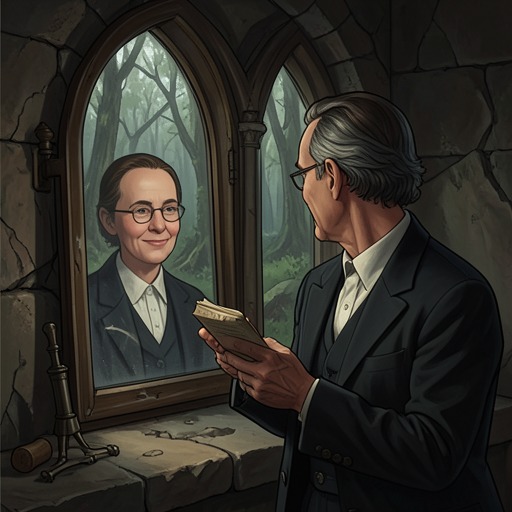
Goldmund’s inherited guilt over his mother
Narcissus and GoldmundGoldmund’s inherited guilt over his mother is a penitential burden imposed on him before he can understand its origins: his father turns the mother’s disappearance and alleged misconduct into a reason that the son must give his life to God in expiation. The belief initially shapes Goldmund’s intended future in the cloister, but Narcissus helps him recover a childhood memory that contradicts the inherited legend. The burden then changes rather than vanishes, reappearing as a less clearly defined sense of guilt and suffering as Goldmund discovers love, freedom, and the transience of life.
Origins of the Burden
Goldmund’s knowledge of his mother first comes not from his own memory but from the story told by his father. In that account she was a beautiful woman of noble but poor birth, a dancer whom her husband claimed to have rescued from poverty and shame. He said he had arranged for her baptism, religious instruction, and marriage, but that after several years of ordered domestic life she returned to her former ways, caused disorder, and left home for days or weeks. Her reputation as a witch followed her; her husband repeatedly brought her back, until she finally disappeared.
The father’s account outlasts the woman herself as a moral explanation for the family’s past. After years of fear and shame, he raises their son, who resembles his mother, while becoming increasingly nagging and bigoted. He instills in Goldmund the idea that a life devoted to God must expiate her sins. The account is therefore more than a tale of an absent parent: it assigns Goldmund a religious vocation in advance, making his existence seem like payment for a fault that he neither committed nor can verify.
Goldmund arrives at Mariabronn carrying this expectation as a secret burden. His father has hinted to Abbot Daniel that the boy should remain in the cloister, but the Abbot does not take the hints as decisive and regards the father with polite reserve. Goldmund, by contrast, understands the proposed monastic life as his father’s wish and command and possibly God’s as well. The narrative presents this sense of destiny as a burden attached to his birth, but one hidden from those around him; even Abbot Daniel does not recognize its force.
A Forgotten Memory and Its Recovery
For years, the father’s version has displaced Goldmund’s own memory. The mother has become a shameful subject he is forbidden to mention, and her story has hardened into a terrible legend made from the father’s account, servants’ reports, and rumors. Goldmund has almost forgotten the image he once possessed of her. The return of that image exposes the difference between inherited judgment and personal memory: the mother he remembers is not the pale, wicked figure of the stories but the beloved presence of his earliest years.
Goldmund tells Narcissus that he had loved and revered his mother unconditionally, and that she had been central to his childhood world. He cannot understand how this radiant memory could have been darkened and replaced by the witch of his father’s account. Its recovery changes his understanding of both his mother and himself. What had seemed a religious obligation to make amends for her sins is revealed as a purpose built on an imposed story, not on Goldmund’s own knowledge or choice.
Narcissus’s role is crucial to this change. He had recognized Goldmund’s hidden wound and, after Goldmund’s profound experience and collapse, appears to have helped him recover what had been suppressed. Goldmund sees that his friend had understood his life with unusual precision. He also seems to shed the belief that he has a special duty to serve God and the mistaken vocation to become a monk. The change is not merely intellectual: Goldmund’s character appears to become at once younger and older, as though recovering an earlier self has released him from the identity his father had imposed.
Guilt Beyond the Cloister
Release from the assigned vocation does not make Goldmund’s later life free of guilt. As a wanderer, he reflects on his growing attraction to women and on the difference between his former religious conscience and his present calm. He recognizes adultery as sin, yet finds that it no longer troubles him in the way it once would have. Instead, he senses guilt for an uncommitted crime, something carried into life rather than arising from a particular act. He wonders whether this is what theology calls original sin.
That reflection connects Goldmund’s private burden to a wider problem of suffering and spiritual discipline. He thinks of Narcissus’s severe penance and asks why a man of such purity and awareness subjects himself to it. The question does not restore the father’s claim that Goldmund must atone for his mother. Rather, it reveals that the experience of guilt has become more complicated than that inherited explanation: Goldmund is free of the specific penitential mission, yet still feels an obscure weight within existence.
The thought occurs alongside Goldmund’s joy in being alive and his awareness that happiness is transitory. He experiences love as a source of pleasure, but also as something that passes quickly, leaving grief and fear of loss. His attention to a small flower, in which he sees minute signs of life, brings together desire, uncertainty, and the limits of knowledge. He feels the urge to think and speak, while recognizing how little even human beings can communicate. In this way, the old burden changes register: it no longer dictates that he become a monk, but remains adjacent to his questions about sin, mortality, and the sorrow that can penetrate happiness.
The Burden Beside Vocation and Work
Goldmund’s later choices make the contrast between imposed atonement and self-discovered vocation concrete. When Master Niklaus offers to help him become an artist, he also explains why Goldmund cannot follow the ordinary guild route: the customary apprenticeship begins in adolescence, requires years of service, and depends on the apprentice’s father paying for it. Goldmund is already too old for that path. Niklaus nevertheless allows him to learn without a contract and to leave whenever he chooses. The offer is significant because it opens a vocation grounded in Goldmund’s ability and choice, rather than a lifelong duty assigned by his father.
Goldmund’s response to settled life remains unsettled. The master’s household, the prospect of money and ownership, and the expectations attached to a recognized craft can repel him. He feels the pride and disdain of the homeless toward those who possess property, and he repeatedly comes close to running away. Yet Niklaus continues to support him because he sees the extraordinary work taking shape in Goldmund’s carving of the Saint John statue. The relationship thus sets artistic commitment beside institutional discipline: Goldmund can learn from a master without being bound by the ordinary contract, even as the making of a work demands sustained labor.
When the statue is complete, Niklaus tries to secure Goldmund’s future. He persuades the guild to issue him a master’s diploma and plans to make him an associate, sharing major commissions and earnings rather than treating him as a subordinate. The plan would also offer a settled place in the workshop and a possible future with Lisbeth. Goldmund’s departure from that prospect underscores that he cannot simply exchange the father’s imposed religious vocation for a secure professional identity. The inherited burden belongs to a larger tension between prescribed lives and a destiny he must discover for himself.
Spiritual Order and the Meaning of Expiation
Goldmund’s return to Mariabronn brings his history into contact with the institution where he once expected to spend his life. He now sees the cloister’s buildings, sculptures, paintings, and teaching as parts of an order accumulated over centuries. The old stone image of the Virgin, which he had known as a boy, appears to him with new clarity; he recognizes a beauty his own work may never surpass. In this setting, he feels small before the unity embodied by the cloister and by Abbot John, formerly Narcissus, whose authority differs from Abbot Daniel’s but serves the same larger order.
This vision reframes the distinction between Goldmund’s former submission and his present relation to the cloister. He considers becoming a lay brother, but recognizes that the change in rank could alter his friendship with Narcissus. More immediately, he wants to work and show what he can do. Narcissus encourages him to clear the practical obstacles from his path and establish a workshop rather than remain restless beside the work he longs to undertake. Goldmund finds a shed near the courtyard gate, commissions tools according to plans he has drawn, chooses timber, builds a roof to protect it while it dries, and works with the blacksmith and his son Erich to prepare his instruments. His artistic vocation takes shape through materials, labor, and relationships, not through a vow of atonement.
Even so, the cloister offers Goldmund a form of discipline that is not simply the punishment his father prescribed. After Goldmund confesses his adventures, sufferings, and sins to Narcissus, the Abbot is less severe about the actual sins than Goldmund expected. He instead reprimands him for neglecting prayer, confession, and communion, and assigns a month of moderation and chastity before communion, daily early mass, and evening prayers. Goldmund is instructed to attend to the meaning of the prayers rather than recite them mechanically. The penance brings him peace and a sense of being gathered into a larger order. It does not reinstate his father’s claim that he must redeem his mother; it shows that spiritual practice can become a chosen discipline that steadies him amid the solitude and intensity of creative work.
The burden’s arc therefore moves from inherited accusation toward recovered memory and a more ambiguous, personal understanding of guilt. Goldmund does not receive a simple explanation that erases suffering or mortality. Instead, he relinquishes the fixed mission imposed on him, pursues an artistic life through his own abilities, and later accepts practices of prayer that differ from compulsory expiation. The distinction between the two forms of discipline is central: the father makes Goldmund answer for his mother, while Narcissus helps him recognize his own nature and offers spiritual order without defining his life as payment for another person’s supposed sins.